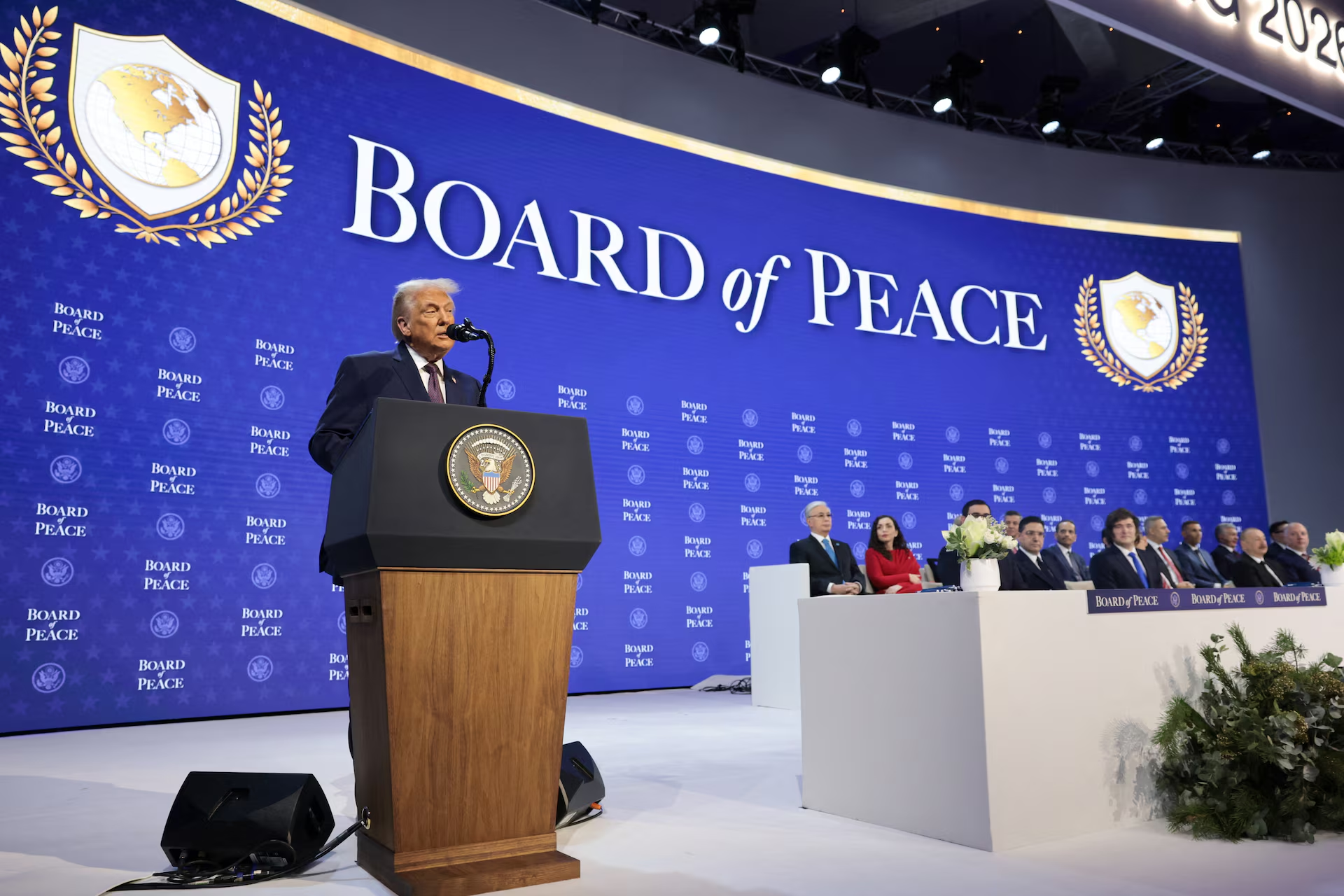
On Thursday, Donald Trump convened the inaugural meeting of his “Board of Peace” at the U.S. Institute of Peace. He recently renamed the building after himself. He declared it “one of the most important days of our careers.” Representatives from 40+ nations gathered. Billions in pledges were announced. FIFA showed up to promise soccer fields. It was a spectacle of peace-making.
That same morning, the Pentagon was loading weapons systems onto cargo planes bound for the Middle East. Two aircraft carrier groups — nearly 80 aircraft, a dozen warships, hundreds of fighter jets — were already positioned near Iran.
Trump’s advisers had told him the military could be ready to strike as early as Saturday. His press secretary had told reporters the day before that “there are many arguments one can make in favor of a strike against Iran.”
Forty countries came to Washington to discuss peace.
The host was simultaneously preparing for war.
This is not a contradiction Trump seems to notice. Or perhaps it’s a contradiction he doesn’t care about, because the Board of Peace was never really about peace to begin with.
The Cool Kids’ Table (and Who Wasn’t Invited)

Before we get to what the Board of Peace is actually planning to do, let’s look at who’s in it. The membership list tells you almost everything you need to know.
Trump sent invitations to roughly 60 countries. The countries that said yes read like a roll call of governments with complicated relationships with democratic norms and international institutions: Hungary (Viktor Orbán), Argentina (Javier Milei), Belarus (Alexander Lukashenko — currently under U.S. and European sanctions for supporting Russia’s invasion of Ukraine), Azerbaijan, Uzbekistan, Vietnam, Kosovo, Albania, Kazakhstan.
Israel signed on, despite Prime Minister Netanyahu holding an active International Criminal Court (ICC) arrest warrant for alleged war crimes. Russia’s Putin received an invitation and was “studying” it.
The countries that said no are a different list entirely. France was first, rejecting the invitation on the grounds that the charter “goes beyond the framework of Gaza and raises serious questions with respect to the principles and structure of the United Nations.”
Germany declined. The UK declined. Spain’s invitation was “under review” — Trump attacked Spain from the podium anyway for defense spending.
Norway said it “raises a number of questions.” Sweden said no. Slovenia’s prime minister said the body “dangerously interferes with the broader international order.”
Austria cited “concerns regarding the charter.” The European Union itself declined membership.

Ukraine rejected its invitation, with its parliament calling the inclusion of Russia and Belarus “absurd” — you cannot chair a peace board while one of your members is actively waging war on another member’s neighbor.
Canada was initially invited, then disinvited by Trump via Truth Social after Prime Minister Carney had the audacity to criticize “American hegemony.”
Not a single country from Sub-Saharan Africa received an invitation at all.
The pattern isn’t subtle. The countries with the most credibility on international law, multilateral institutions, and human rights — the ones whose participation would actually legitimize a peace process — looked at the charter and walked away.
The countries that joined are largely those that either depend on U.S. favor, have authoritarian leaders who prefer Trump-style bilateral deal-making to rules-based international order, or are small enough that being personally invited by the American president felt like a diplomatic win regardless of the substance.
There’s also a membership fee: a permanent seat costs $1 billion, paid into a fund controlled by Trump. So it’s a peace club with a cover charge, chaired for life by a man who can revoke your invitation if you say something he doesn’t like.
And then there’s Belgium, which was falsely listed by the White House as a signatory.
Belgium’s foreign minister had to post on social media to clarify: “Belgium has NOT signed the Charter of the Board of Peace. This announcement is incorrect.” The Board of Peace couldn’t even accurately report its own membership on day one.
Notably absent from any of this: Palestinians.
The Palestinian Authority’s prime minister said he wanted to “work with” the Board of Peace, but Palestinians hold no seat, no vote, no veto — not even the nominal representation that the UN Security Council resolution that authorized the board had explicitly called for.
The EU’s High Representative pointed out that the UN resolution “provided for the Palestinians to have a say,” but Trump’s charter contains no such provision.
It also, remarkably, makes no direct mention of Gaza at all — the place the whole thing was supposedly created to help.
“Peace” Without the People It’s Supposed to Help

Here is what you need to know about who designed the “New Gaza” plan that the Board of Peace exists to implement: it was created by Jared Kushner — a real estate developer and Trump’s son-in-law — with an Israeli billionaire real estate investor named Yakir Gabay playing, in Kushner’s own words, “a key role.” NPR’s reporting found it’s unclear if any Palestinians were consulted at all.
It’s worth pausing on who Jared Kushner is to the people he’s negotiating with. According to the New York Times, Russian diplomats have taken to calling the U.S. negotiating team “Witkoff and Zyatkoff” — because “zyat” is Russian for son-in-law.
The Iranians have their own nickname for him: “Damad Trump” — using the Persian word for son-in-law. Both the Russians and the Iranians — the people across the table in two of the most consequential diplomatic efforts of the decade — don’t define Kushner by any credential, expertise, or title. They define him by who he married.
He has no official government role, has never faced Senate confirmation, and holds no relevant credentials in diplomacy, international law, urban planning, or Palestinian history.
What he has is a father-in-law who is president, and several billion dollars raised from the Gulf states and sovereign wealth funds of countries he’s now overseeing “peace” for.
Read that again. The plan for what happens to Gaza — to its land, its neighborhoods, its future governance — was designed by an Israeli real estate investor and the president’s son-in-law. The people who actually live there appear not to have been asked.
A Palestinian woman interviewed by NPR didn’t mince words: “This is not Gaza. All our rights and homes are gone in this plan. Just bring in aid and open the border for us. The plans being drawn up are for investors and tourists, not for the people who live here.”
She’s right.
Kushner’s “New Gaza” envisions loft apartments with floor-to-ceiling windows, coastal tourism zones, data centers, luxury towers along the Mediterranean.
One architecture professor called it the “Vegas-ification” of Gaza — “gated communities designed for a specific economic class, rather than an organic city fabric that serves the local population.”
Critics have pointed out that the plan doesn’t address how the 2.2 million people currently living in Gaza would afford any of it, or where they’d go during the two to three years of construction. It doesn’t describe how families would be relocated from buildings the plan requires demolishing. It makes no reference to land deed transfers or how housing would be allocated.
When Trump himself was asked whether displaced Palestinians would have the right to return, his answer was: “Why would they want to return?”
That tells you everything about the nature of this “peace.”
This Is Not a New Story

To understand why the Board of Peace represents something deeper than Trump-era cynicism, you need the longer history — the roughly 160 years of it.
Palestinian displacement didn’t begin on October 7, 2023. It didn’t begin in 1967, or 1948.
It traces back to the late 19th century, when the Ottoman Land Law of 1858 allowed absentee landlords to legally sell land that Palestinian farmers had worked for generations — land the farmers hadn’t formally registered, because registering it with the Ottoman government meant being taxed and conscripted.
Through this legal mechanism, Palestinian families who had lived on and worked land for centuries found themselves tenants on property they’d never stopped inhabiting, which could now be sold to Zionist land-purchase organizations without their consent.
The pattern was set early: legal and bureaucratic mechanisms that produced Palestinian displacement while maintaining the appearance of legitimacy.
It continued through the WWI era, when Britain made three separate, contradictory promises about the same territory. To Sharif Hussein of Mecca, they promised Arab independence.
In the secret Sykes-Picot Agreement, they divided the region between Britain and France. And in the Balfour Declaration, they promised a Jewish homeland in Palestine — a place where hundreds of thousands of Arabs already lived. The people whose land it was weren’t party to any of these agreements.
The 1948 Nakba — “catastrophe” in Arabic — was the catastrophic culmination of that period. More than 700,000 Palestinians fled or were expelled from their homes.
The villages they left were systematically demolished so they couldn’t return. The UN recognized their right of return; Israel refused to honor it.
That population became the refugee camps of Gaza and the West Bank, a displacement that is now in its fourth generation.
Every “peace process” since then — Oslo, Camp David, the Abraham Accords — has been negotiated largely over Palestinian heads rather than with them, and every one has left Palestinians with less land, less autonomy, and fewer rights than before it started.
The Oslo Accords, which Palestinians signed in good faith, became the legal framework under which settlement expansion accelerated. The land set aside for a future Palestinian state has been eaten away, piece by piece, for thirty years.
So when Kushner stands up at Davos and unveils “New Gaza” to a room full of investors — with no Palestinian representation on the Board of Peace, no Palestinian input into the reconstruction plan, no guarantee that Palestinians would own or afford what gets built on the ruins of their homes — it isn’t an anomaly.
It is the same pattern, dressed in better graphics. The same logic that has governed every chapter of this story: decisions about Palestinian land made by everyone except Palestinians.
The Board of Peace doesn’t break that pattern. It perfects it.
The Arsonist’s Peace Plan

There’s a particular cruelty to the timing that deserves to be named plainly.
The land that Kushner wants to redevelop was made available for redevelopment by a war in which the United States was a direct participant. And it’s not just the Trump Administration that holds accountability here.
Biden sent weapons. Congress sent weapons. This is a whole-of-government accountability.
The U.S. supplied the weapons that destroyed Gaza. The U.S. provided diplomatic cover that shielded Israel from international accountability.
The U.S. joined Israel’s strikes on Iran’s nuclear facilities in June 2025. And now the U.S. is presenting itself as the neutral party best positioned to oversee Gaza’s reconstruction — and collecting pledges to do it.
The Board of Peace is named after peace. It is funded by the people who enabled the destruction. It is managed by an executive board that includes Netanyahu — a sitting ICC indictee — and has extended an invitation to Vladimir Putin, another ICC indictee.
It is chaired by a man who, on the day of its inaugural meeting, was actively considering ordering military strikes on a neighboring country.
At the same moment, Trump was accepting pledges for Gaza’s reconstruction from Gulf states. They were privately lobbying him not to attack Iran.
Such a strike would immediately destabilize the entire region. It would collapse whatever fragile architecture the Board of Peace is trying to build.
It could potentially ignite a war. Analysts describe this war as likely to be a weeks-long campaign broader in scope than anything the region has seen in decades.
And all this in the wake of having effectively conquered Venezuela.
This is not a peace strategy with a war problem on the side. The war is the strategy. The Board of Peace is the branding.
The Constitutional Problem Nobody Is Talking About

Here is something that has gotten almost no public attention: Congress has not authorized military action against Iran. Not now. Not when Trump bombed Iran’s nuclear facilities last June either.
Senators Tim Kaine and Rand Paul — a Democrat and a Republican — introduced a bipartisan War Powers Resolution requiring any hostilities with Iran to be explicitly authorized by Congress.
“Iran has not attacked the United States,” the coalition supporting the resolution noted, “nor threatened an offensive strike, and Congress has not authorized any military action against Iran.”
The Senate voted it down 53-47, almost entirely along party lines. Rand Paul was the only Republican willing to stand with the Constitution’s plain language: Congress declares war. Not the president.
So now we are potentially days away from a president unilaterally launching what his own advisers describe as a massive, weeks-long military campaign — one that would look “more like full-fledged war than last month’s pinpoint operation in Venezuela” — against a country that has not attacked us, without a declaration of war, without congressional authorization, with no public articulation of what success would even look like.
And the day before he potentially does that, he hosted a peace summit.
What “Peace” Actually Means Here

Let’s be direct about what the Board of Peace is and isn’t.
It isn’t a peace process, because the people it most directly affects — Palestinians — weren’t included in designing it, aren’t represented on the board that governs it, and can’t afford what it plans to build on their land.
It isn’t a neutral international body: It’s a Trump-branded institution, chaired by Trump, which Trump has said will eventually “look over the United Nations and make sure it runs properly.”
It includes ICC-indicted war criminals. Its reconstruction plan was co-designed by an Israeli real estate investor.
So-called Phase 1 of the “peace plan” has been a joke. The ceasefire has been violated 1,620 times since October, with 601 Palestinians killed and another 1,607 injured in the “post-war” period.
But sure, four Israeli soldiers were killed.
What it is, is this: the latest iteration of a 160-year pattern of managing Palestinian land and Palestinian people without Palestinian consent.
Dressed up in the language of investment and opportunity and hope, presented with AI-generated renderings of glass towers and marinas, backed by $17 billion in pledges, and announced the morning before the host considered ordering airstrikes on the country next door.
Trump called it “one of the most important days of our careers.” He held it at his eponymous building. He said he wants it to eventually oversee the United Nations–which is to say, he want himself to oversee the UN.
And while he was saying all of this, his press secretary was explaining to reporters why bombing Iran might be a good idea.
This is what peace looks like when it’s a brand instead of a principle — when the people it’s supposed to serve aren’t in the room, when the peacemaker is also the arsonist, and when the land being rebuilt is valued more as waterfront property than as someone’s home.
The Board of Peace met on Thursday. The Board of War never adjourned.
Leave a Reply