The Supreme Court handed down one of the most consequential economic rulings in decades yesterday, and predictably, the media coverage has been swallowed whole by the spectacle.
Trump calling his own appointed justices “a disgrace to our nation” and “an embarrassment to their families.” Governor Pritzker sending Trump a $8.7 billion invoice stamped “Past Due – Delinquent.”
The president signing a new 10% global tariff within hours using a different law as if to say I don’t need your stinkin’ Constitution.
All of it is compelling theater. None of it is the real story. Let’s keep our eye on the ball here. Trump is actively harming the bottom 80% of the country’s income earners.
The real story is what happened to American small businesses and working families over the past year while the lawyers argued and the courts deliberated.
The real story is $85 billion in annual tariff costs absorbed by small businesses that didn’t have the reserves to wait for legal vindication.
The real story is a congressional study finding that American families spent roughly $1,200 more last year because of tariffs — and that number was climbing toward the $1,600–$2,000 range that Yale’s Budget Lab projected before the ruling came down.
Pritzker’s $1,700-per-family figure didn’t materialize from partisan math. It came from research.
And here’s the part that nobody is saying loudly enough: most of those families aren’t getting that money back.
The Damage Was Structural, Not Theoretical
While large corporations stockpiled inventory before the tariffs hit and leveraged economies of scale to absorb the shock, small businesses had no such runway. JP Morgan Chase published research just this week showing that tariff bills for mid-sized American businesses tripled over the course of 2025.
These are companies employing a combined 48 million people — the exact businesses Trump promised to revive. They paid first, they hurt first, and they will benefit last, if at all.
At this point, it’s worth taking a moment to contrast what Trump’s victory claims are with the actual reality.
Trump likes to crow about bringing in $21 trillion with his new trade deals. The important thing to know about that is that it’s completely made up. The actual pledges are about a third of that, and there is no enforcement mechanism.
In brief, they are just telling Trump what he wants to hear, knowing he’s going to be gone in a few years, and there’s nothing he can do about it.
The actual numbers tell a damning story even with full 2025 annual data not yet published — the Bureau of Economic Analysis (BEA) doesn’t release that until July 2026.
What we do know is that full-year 2024 FDI flows into the US came in at $292 billion, itself already a weak year described by analysts as below the decade average.
Then Liberation Day hit. Q1 2025 — the first quarter under the tariff regime — collapsed to $52.8 billion, a 34% drop from the prior quarter and the second-weakest quarter since 2022.
Projected out, that pace puts 2025 on track for roughly $211 billion in FDI — a nearly 28% decline from 2024, in a year when Trump was promising trillions in new investment.
The bottom line is foreign countries are investing less in America, not more.
And American businesses are being hurt.
The American Action Forum estimated direct tariff costs to small businesses at approximately $85 billion annually, potentially reaching $100 billion.
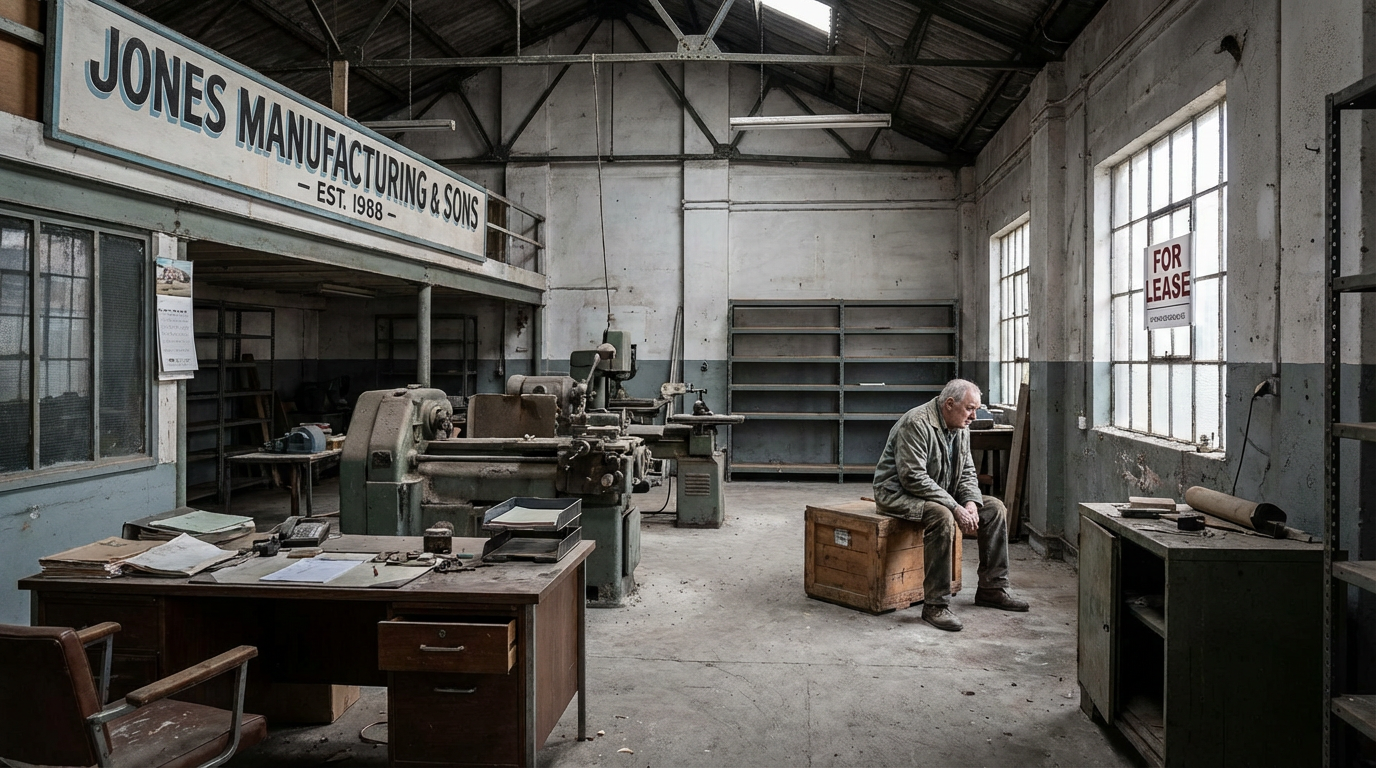
For companies with slim margins, no pricing power with suppliers, and no army of trade lawyers to navigate exemption applications, that wasn’t an accounting entry — it was an existential threat.
The testimonies tell the story in granular terms. A footwear CEO who couldn’t sleep, took out a $250,000 loan to pay a single tariff bill on a container of shoes, and had to cut his holiday inventory order in half.
A small products company that was forced into bankruptcy because they couldn’t afford to relocate their manufacturing molds after tariffs made their existing production line economically impossible.
Business owners across the country who froze hiring, killed raises, pulled back expansion plans, and asked themselves how much longer they could keep the doors open.
Employment data echoed the human stories.
By September 2025, small businesses with 1–19 employees had shed 60,000 jobs — the fifth straight month of declines — while large businesses were actually adding 33,000 positions.
The K-shape was widening in real time, and most of the analysis was focused on whether Trump would win at the Supreme Court rather than on the workers and owners on the losing end of that divergence.
The K-Shape Nobody Is Naming

This is the through-line that’s getting lost: tariffs didn’t hurt everyone equally. They operated as a regressive tax — exactly the kind of policy that accelerates the K-shaped economy we’ve been documenting.
Large corporations had the tools to survive. They front-ran the tariffs with inventory purchases, secured exemptions through lobbying, diversified supply chains, and passed costs on to consumers without losing market share because their competitors faced the same pressure.
Big retailers stockpiled inventory months before tariffs kicked in, locking in pre-tariff pricing while smaller merchants scrambled to pay duties upfront at the port.
Only about 27% of small importers have strong enough credit scores to get new loans, compared to 70% of large importers. Large corporations literally had the credit access to frontrun the tariffs. Small businesses didn’t.
The big dogs’ quarterly reports stayed strong. The S&P 500 hovered near record highs. Investors shrugged.
Meanwhile, the businesses that couldn’t absorb the shock raised prices on the working families who were already stretched by inflation.

Those families paid more at the grocery store, the hardware store, and the kitchen table — to use Pritzker’s framing — while their wages didn’t keep pace.
The households at the bottom of the K were funding, through higher everyday prices, a policy whose primary beneficiaries were the corporations and investors at the top.
The Tax Foundation put the total tariff burden at an average of $1,000 per household in 2025, rising to $1,300 in 2026. Those averages, as always, obscure the distributional reality.
For households spending a larger share of income on goods — lower-income families, rural families, small business owners reinvesting in their operations — the burden was considerably higher. For wealthy households with more services and less goods in their consumption basket, it was considerably lower.
What “Victory” Looks Like When You’re a Small Business
The Supreme Court ruled 6-3 that IEEPA — the 1977 emergency powers law Trump used to impose his sweeping global tariffs — does not authorize the president to impose tariffs.
Chief Justice Roberts was blunt: the law “contains no reference to tariffs or duties,” and “until now no President has read IEEPA to confer such power.”
This wasn’t a close call. It was a bipartisan rebuke across ideological lines, with Trump’s own appointees Neil Gorsuch and Amy Coney Barrett joining the majority.
The government has collected over $133 billion in IEEPA tariffs as of mid-December, with estimates suggesting the figure reached at least $160 billion by the time the ruling came down.
Importers who paid those duties are now lining up for refunds. Costco, Revlon, Bumble Bee Foods — companies large enough to have already filed pre-emptive lawsuits — are positioned near the front of that line.
And consumers? According to trade lawyers and economists cited in multiple analyses this week, the higher prices that were passed through to households will be extraordinarily difficult to recover. The refund mechanism flows to importers, not to the families who ultimately bore the cost through price increases.
The working family that paid more for shoes, appliances, tools, and food over the last year has essentially no legal path to restitution. That $1,700 is just gone.
Meanwhile, Trump signed a new 10% global tariff within hours of the ruling, invoking Section 122 of the Trade Act of 1974. Then he boosted that to 15% today.
That authority allows him to impose tariffs for up to 150 days without congressional approval, potentially renewable. Treasury Secretary Scott Bessent was already on the circuit reassuring investors that “virtually unchanged tariff revenue” would be maintained in 2026 using alternative legal authorities.
The policy isn’t going away. The small business owner who went bankrupt waiting for legal vindication doesn’t get to reopen.
The Story We Should Be Telling
Yes, Trump’s meltdown is newsworthy. A sitting president attacking the justices he appointed, calling them an embarrassment to their families, and immediately announcing he’ll do an end-run around the ruling — that belongs in the coverage.
But the drama is functioning as a distraction from accountability. If we spend the week talking about Pritzker’s invoice and Trump’s temper tantrum, we don’t have to talk about the $85 billion in small business costs that won’t be recovered, or the employment losses concentrated in exactly the sector Trump claimed to champion, or the families who paid a hidden tax for a year and will see none of it returned.
The K-shaped economy doesn’t happen in a single dramatic event. It accumulates in the gap between what large corporations can survive and what small businesses can’t, between the refunds that go to corporate importers and the higher prices that stay with working families, between the investors who watched the S&P stay near record highs and the business owners who took out emergency loans to stay solvent.
Yesterday’s ruling was a legal victory. But for the small businesses that didn’t survive the wait, and for the families who absorbed costs they’ll never recover, it’s closer to a verdict on damage already done.
That’s the story worth telling.
Leave a Reply